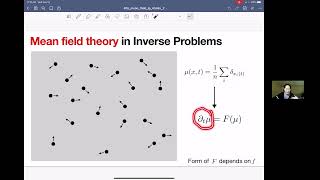
Useful Starting Point: Why direct networks fail; Bayesian inference with diffusion priors and posterior sampling. Presentation given by Qin Li on November 10, 2021 in the one world seminar on the mathematics of

Lecture 9 Machine Learning For Inverse Problems - Follow-Up Ideas for Readers

This reference brings together Lecture 9 Machine Learning For Inverse Problems with background information, practical notes, and nearby searches so the subject feels less scattered.

In addition, this page also connects Lecture 9 Machine Learning For Inverse Problems with for broader topic coverage.

Follow-Up Ideas for Readers

Presentation given by Qin Li on November 10, 2021 in the one world seminar on the mathematics of Why direct networks fail; Bayesian inference with diffusion priors and posterior sampling.

Wardrobe Main Overview

A clean overview helps readers understand Lecture 9 Machine Learning For Inverse Problems before moving into details, examples, or connected topics.

Wardrobe Important Notes

This section highlights the practical pieces readers may want before opening a more specific related page.

Clothing How People Use It

Context matters because Lecture 9 Machine Learning For Inverse Problems can connect to nearby topics, related searches, and different reader intents.

Main details to review

  • Presentation given by Qin Li on November 10, 2021 in the one world seminar on the mathematics of
  • Why direct networks fail; Bayesian inference with diffusion priors and posterior sampling.
  • Discussed about Convex function, Gradient Descent and Gradient Ascent Algorithms in a very simple way.

Why this topic is useful

This page works best as a lightweight hub for scanning and continuing research.

Sponsored

Reader Questions

How does Lecture 9 Machine Learning For Inverse Problems connect to accessory?

Lecture 9 Machine Learning For Inverse Problems can connect to accessory when readers need context, examples, comparisons, or practical next steps inside the same topic area.

Why might Lecture 9 Machine Learning For Inverse Problems have several meanings?

Different pages may focus on different locations, dates, providers, versions, definitions, or user needs.

How can related pages improve understanding of Lecture 9 Machine Learning For Inverse Problems?

Related pages add context, alternative wording, practical examples, and follow-up paths for deeper research.

Image References

Lecture 9: Machine Learning for Inverse Problems
SP15 Lecture 21 Part 9 MIRA
Lecture 9 | Machine Learning (Stanford)
Machine learning in solution of inverse problems: a subjective perspective
Rebecca Willett: "Machine Learning for Inverse Problems in Climate Science"
Simon Weissmann - Surrogate based one-shot formulation for inverse problems and optimization
MDS20 Minitutorial: Solving Inverse Problems with Deep Learning by Lexing Ying
Qin Li - Mean field theory in Inverse Problems: From Bayesian inference to overparametrized networks
Solving Inverse Problems with Deep Learning by Lexing Ying
Introduction to Machine Learning, Lecture- 9 (Gradient Descent Algorithm as Optimizer).
Sponsored
Explore Topic Paths
Lecture 9: Machine Learning for Inverse Problems

Lecture 9: Machine Learning for Inverse Problems

Why direct networks fail; Bayesian inference with diffusion priors and posterior sampling.

SP15 Lecture 21 Part 9 MIRA

SP15 Lecture 21 Part 9 MIRA

Read more details and related context about SP15 Lecture 21 Part 9 MIRA.

Lecture 9 | Machine Learning (Stanford)

Lecture 9 | Machine Learning (Stanford)

Read more details and related context about Lecture 9 | Machine Learning (Stanford).

Machine learning in solution of inverse problems: a subjective perspective

Machine learning in solution of inverse problems: a subjective perspective

Read more details and related context about Machine learning in solution of inverse problems: a subjective perspective.

Rebecca Willett: "Machine Learning for Inverse Problems in Climate Science"

Rebecca Willett: "Machine Learning for Inverse Problems in Climate Science"

Read more details and related context about Rebecca Willett: "Machine Learning for Inverse Problems in Climate Science".

Simon Weissmann - Surrogate based one-shot formulation for inverse problems and optimization

Simon Weissmann - Surrogate based one-shot formulation for inverse problems and optimization

This talk was part of the Workshop on "PDE-constrained Bayesian

MDS20 Minitutorial: Solving Inverse Problems with Deep Learning by Lexing Ying

MDS20 Minitutorial: Solving Inverse Problems with Deep Learning by Lexing Ying

Read more details and related context about MDS20 Minitutorial: Solving Inverse Problems with Deep Learning by Lexing Ying.

Qin Li - Mean field theory in Inverse Problems: From Bayesian inference to overparametrized networks

Qin Li - Mean field theory in Inverse Problems: From Bayesian inference to overparametrized networks

Presentation given by Qin Li on November 10, 2021 in the one world seminar on the mathematics of

Solving Inverse Problems with Deep Learning by Lexing Ying

Solving Inverse Problems with Deep Learning by Lexing Ying

Read more details and related context about Solving Inverse Problems with Deep Learning by Lexing Ying.

Introduction to Machine Learning, Lecture- 9 (Gradient Descent Algorithm as Optimizer).

Introduction to Machine Learning, Lecture- 9 (Gradient Descent Algorithm as Optimizer).

Discussed about Convex function, Gradient Descent and Gradient Ascent Algorithms in a very simple way.